

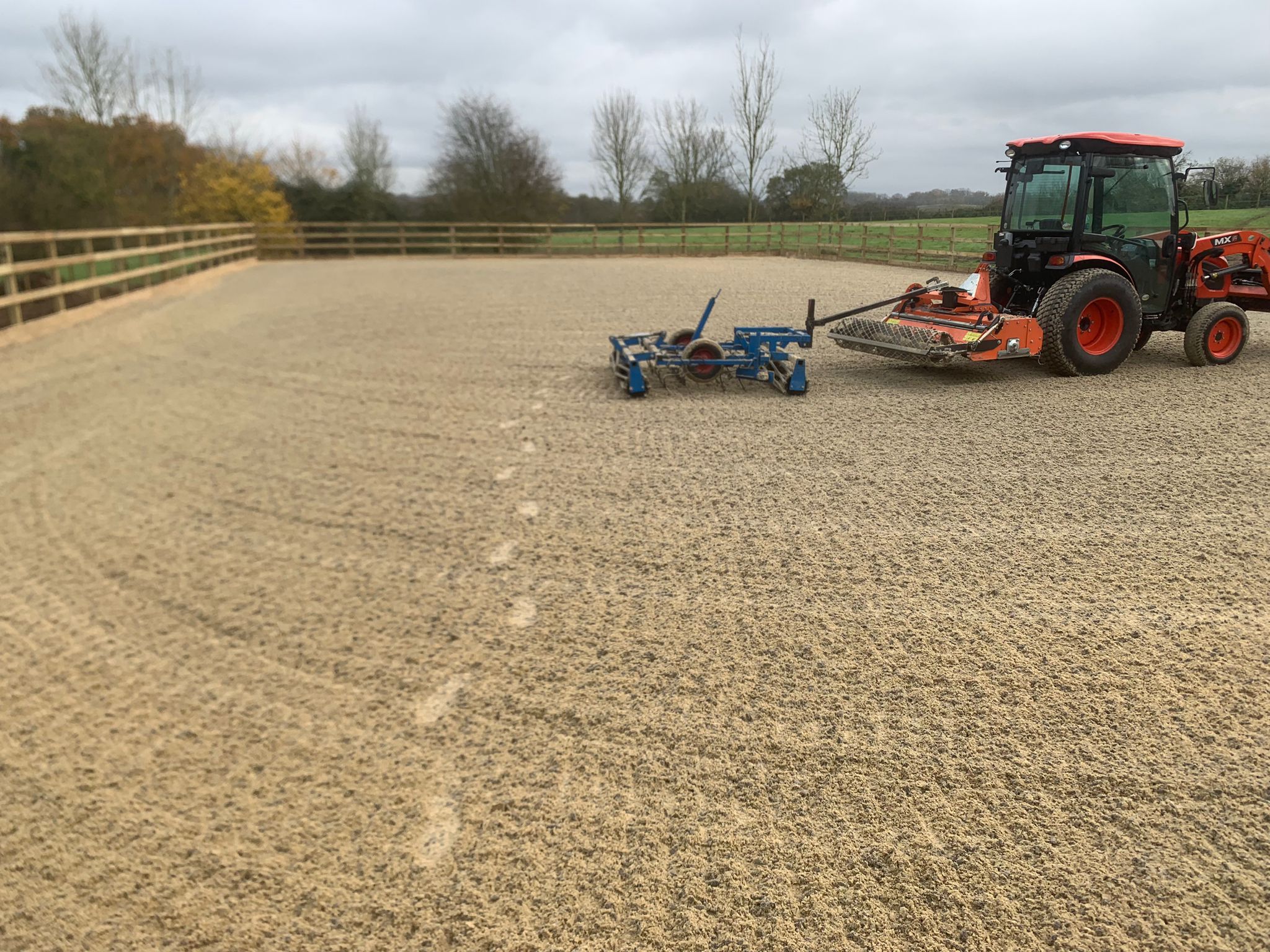
Understanding How Moisture Levels Change Arena Behaviour
Whether you ride in the height of summer or through a wet British winter, the amount of moisture in your arena surface is one of the most powerful forces shaping how your horse moves, how the surface responds underfoot, and how safe every session is. Yet moisture is often an afterthought, something riders notice only when the arena is obviously flooded or bone dry.
The truth is that moisture operates on a spectrum, and every point along that spectrum changes arena behaviour in ways that directly affect your horse’s welfare and performance.
Understanding this relationship is the foundation of good arena management, and it starts with understanding your arena drainage system. At Combi-Ride, this is a principle we prioritise across every arena system we design.
The Moisture Spectrum: From Waterlogged to Bone Dry
Arena surfaces aren’t just “wet” or “dry”, they behave very differently depending on how much moisture is in them.
Saturated (waterlogged)
When an arena holds more water than it can drain or evaporate, particles become suspended rather than interlocked. The result is an unstable surface where hooves sink unpredictably, traction is reduced and the risk of slipping or strain increases. In most cases, this is a drainage issue, not just a rainfall issue.
Overly moist
Just below saturation, arenas can feel rideable but still lack consistency. The surface shifts underfoot, making it harder for horses to push off confidently, particularly during lateral work or tighter movements.
Optimally moist
There is a sweet spot where moisture acts as a binder. Light moisture binds sand, fibre and rubber together, allowing the surface to compress and rebound correctly. It’s this balance of grip and cushioning that supports safe, effective movement, something Combi-Ride surfaces are engineered to maintain across varying conditions.
Dry
As moisture drops, cohesion is lost. Surfaces become loose, dust increases, and footing becomes less predictable, placing additional strain on tendons and ligaments.
Desiccated (overly dry and compacted)
At the extreme dry end, compaction takes over. The surface hardens, shock absorption decreases, and long-term joint stress increases, effectively turning the arena into a firm track.
You can read more about how compaction affects surface behaviour in our guide to The Science of Compaction: What Makes an Arena Too Deep?
Why Drainage Is the Starting Point
Before considering watering routines or surface materials, drainage must come first. Effective arena drainage isn’t just about removing standing water, it’s about allowing the arena to return to its optimal state quickly and consistently after rainfall.
A properly designed system typically includes:
- A graded sub-base to encourage water movement
- A permeable membrane to prevent contamination
- Drainage layers (pipes or aggregate) to channel water away
- A surface layer with suitable permeability
When any of these elements are compromised, moisture has nowhere to go. This is why, at Combi-Ride, drainage design is always addressed before recommending any surface solution, because even the most advanced materials cannot compensate for a failing base.
How Different Surfaces Respond to Moisture
Not all arena surfaces react to moisture in the same way. Understanding how your specific surface material behaves is key to managing it well.
Sand-Only Arenas
Highly moisture-dependent, with a narrow optimal range. Too dry and they become loose; too wet and they lose structure, making drainage especially critical.
You can explore our Equestrian Sand Arena Surfaces range to see how sand grade affects both drainage and moisture retention.
Sand and Fibre Surfaces
Fibres create a stabilising matrix, helping the surface hold together across a wider moisture range. This improves consistency and recovery after rainfall (a key advantage in UK conditions!)
Our Dual-Stabiliser Fibre and Combi-Pro Advanced Fibre products are specifically engineered to provide this kind of structural resilience in British weather conditions.
Waxed Surfaces
Designed to shed water more efficiently, maintaining more consistent footing in wetter climates while also reducing dust in dry periods.
Our Combi-Wax product is designed specifically for arenas that need reliable performance across a wide moisture range, an excellent option where riding arena drainage challenges have historically caused problems.
Combi-Ride surface systems are designed with these interactions in mind, ensuring consistent performance throughout seasonal changes.
How Moisture Changes Horse Behaviour in the Arena
Surface conditions directly influence how horses move and respond:
On Wet or Saturated Surfaces
Horses may shorten their stride, show reluctance in lateral work, or lose confidence in transitions due to reduced stability. The connection between surface conditions and behaviour is explored in more depth in our articles on how arena surfaces influence horse straightness and balance and footing fatigue and training quality.
On Dry or Compacted Surfaces
Increased concussion can lead to fatigue, stiffness and long-term strain, while dust can irritate the respiratory system. For a detailed look at how surface conditions affect long-term health, see our guide on prioritising horse health from hoof to heart.
Consistent footing allows horses to move freely, confidently and correctly, supporting both performance and long-term health.
Seasonal Moisture Challenges in the UK for Horse Arenas
British weather makes moisture management a year-round challenge. The pattern of wet winters followed by dry spells in spring and summer means the same arena can cycle through very different moisture states within weeks.
Winter and Autumn: High rainfall puts drainage systems under pressure For specific guidance on this period, our Seasonal Arena Care: Preparing for Autumn guide is a useful resource.
Spring: Uneven drying can create inconsistent layers
Summer: Dry conditions increase dust and require active watering
How Can You Manage Horse Arena Surface Moisture?
Watering: Water should be applied evenly across the whole arena, not just in the areas of heaviest use. A light, even application repeated as needed is better than a single heavy soaking.
Harrowing: Regular harrowing redistributes surface particles and helps moisture penetrate evenly rather than concentrating in worn tracks. See our full Arena Maintenance guidance for recommended routines.
The handful test: Take a handful of surface material and compress it in your fist. If it forms a ball that holds its shape briefly before crumbling, moisture is close to optimal. If it runs through your fingers, it’s too dry. If it stays as a sticky mass and water oozes out, it’s too wet.
Surface topping: A thinned surface drains more quickly, narrows the optimal moisture window and becomes more prone to both drying out and waterlogging. Our guide on how often you should top up your equestrian surface covers this in detail.
When to Reassess Your Drainage
Persistent moisture issues often point to deeper problems. Warning signs include:
- Standing water after moderate rainfall
- Surfaces remaining wet for extended periods
- Ongoing soft or uneven patches
- Noticeable changes in surface level
If these issues occur, it may be time to review the drainage system rather than the surface alone. Our team at Combi-Ride can advise on both surface and drainage solutions, so contact us to discuss your arena’s specific challenges.
Choosing the Right Surface for Your Moisture Conditions
Moisture management is closely tied to surface choice and usage. A dressage arena in a high-rainfall area will have very different requirements to a jumping arena on naturally free-draining ground.
At Combi-Ride, our surfaces are designed to perform across a wide range of UK conditions, but always as part of a complete system that includes proper drainage and ongoing maintenance.
If you manage a private yard or competition venue and want to understand more about how your current arena is performing, explore our full range of equestrian arenas and surface products or get in touch for a free, no-obligation consultation.