

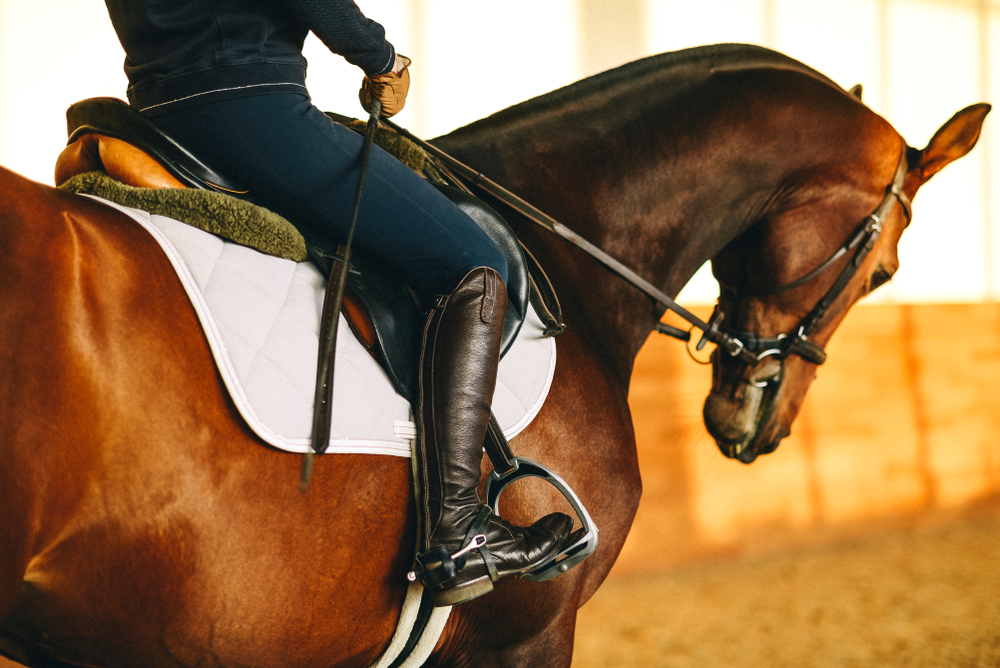
How Arena Footing Affects Rider Confidence and Training Quality
There is a conversation that happens a lot in equestrian circles about training programmes, schooling techniques and horse fitness. But the surface under your horse’s feet rarely gets the attention it deserves.
Arena footing shapes every session you ride, not just in terms of horse welfare, but in terms of how confident you feel in the saddle and how much genuine progress you make.
If you have ever ridden a horse that felt inconsistent or difficult to read, then ridden that same horse on better footing, you will have felt the difference instantly. Often, it is not the horse that changed. It is the surface allowing you to ride with clarity and confidence instead of hesitation.
At Combi-Ride, it is something we consider with every arena we design. If you are unsure where your current surface sits, get in touch with our team, and we can help you assess it.
What Does Arena Footing Actually Do to Your Ride?
Arena surfaces don’t simply switch between wet and dry. They sit somewhere on a spectrum. Every point along it changes the way your horse moves and how confident you feel in the saddle.
Waterlogged: When drainage is overwhelmed, the surface becomes unstable. Your horse loses traction, and you instinctively hold back. Confidence drops immediately because you cannot rely on the ground beneath you.
Too wet (but rideable): The surface may feel usable, but inconsistency creeps in. When the footing shifts during transitions or lateral work, you start second-guessing your aids rather than riding positively.
Optimal: This is where confidence is built. The right level of moisture binds the surface, creating consistent grip and cushioning. Your horse moves freely, and you can focus on accuracy, not risk management.
Too dry: As cohesion is lost, the surface becomes loose and unpredictable. You naturally ride more conservatively, limiting impulsion and avoiding movements that require commitment.
Compacted and hard: With no give in the surface, shock absorption disappears. Your horse protects itself, and you become more cautious without always realising why. It becomes difficult to ride forward with confidence.
Understanding where your arena sits on this spectrum is the foundation of good management. From this, choosing the right surface from the outset makes it far easier to stay in that optimal window.
Our guide to understanding how moisture levels change arena behaviour covers the practical signs of each condition and what to do about them.
Why Does Poor Footing Affect Rider Confidence?
This is the part of the arena footing and rider confidence conversation that doesn’t get said enough: when you don’t trust the surface, you don’t trust your ability. You don’t ask for that extended trot. You back off the canter transition. You avoid the corner where the ground always feels slightly different.
That caution is sensible. But over time, it limits both you and your horse. Sessions become about managing around the surface rather than actually training. Progress slows, frustration builds and the horse, who can also notice every change underfoot, begins to reflect that tension back at you.
Poor footing increases the physical effort your horse needs to stay balanced, shortening productive training time and reducing the quality of work you can achieve in each session.
When the surface is consistent, that mental load disappears. You can focus on timing, feel and accuracy, rather than constantly adjusting for the ground beneath you.
If your sessions have started to feel harder than they should, it is worth speaking to the Combi-Ride team before assuming the problem is the horse or the training.
Does Arena Footing Matter Differently for Dressage and Show Jumping?
Safe arena footing supports confidence in every discipline, but the way that confidence shows up differs depending on how you ride.
Dressage
Dressage places a premium on cushioning and consistency. Collection, lateral work and precise transitions all require a horse to push off and land with confidence in exactly the same surface response each time.
A surface that is slightly deeper on the tracks or that dries unevenly will quietly undermine straightness and balance. For dressage riders, a fibre-blended surface with good moisture retention is key. Our Combi-Pro Advanced Fibre is designed to offer exactly that stability and energy return.
Show Jumping
In show jumping, confidence comes from knowing your horse can push off and land safely every time. You need to be able to commit to a line without hesitation.
If the surface is too deep or too firm, that trust disappears. Take-offs become laboured, landings feel jarring, and you instinctively ride more cautiously. The science of compaction matters enormously here.
At Combi-Ride, our show jumping arenas are designed to provide consistent grip and energy return, supporting both performance and your confidence.
How Do I Choose the Right Arena Surface?
The right surface is not just about technical performance, it is about creating an environment where you can ride with confidence every day.
That depends on your discipline, your drainage setup and how consistently you can maintain your arena.
Our Dual-Stabiliser Fibre suits arenas that need consistent, cushioned footing across changing conditions. All of our surfaces are designed and manufactured in the UK as part of a complete system; drainage, sub-base and surface working together.
Whether you are looking to have a new arena built or refresh your existing one, explore our full range of arena surfaces or get in touch for a free, no-obligation consultation with the Combi-Ride team.