

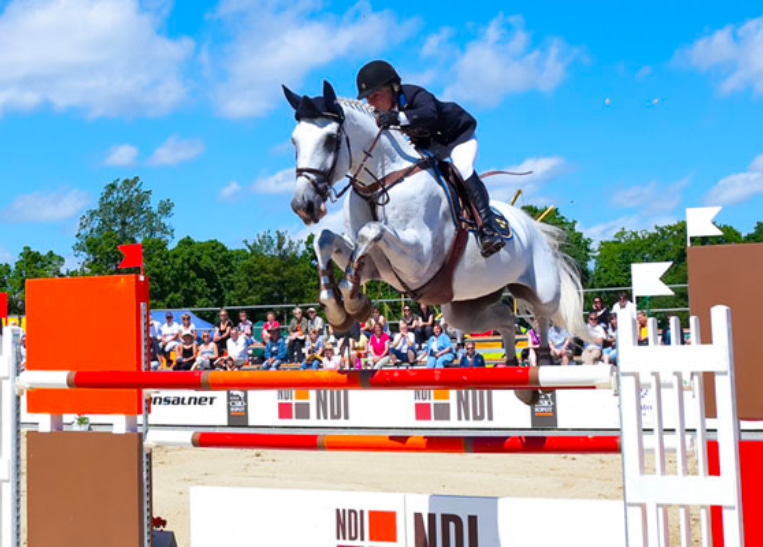
Does Arena Footing Affect Jumping Confidence?
Arena footing can absolutely affect a horse’s jumping confidence. Deep, hard or uneven surfaces can make take-off and landing less predictable. Over time, this may cause hesitation, changes in rhythm or reluctance to jump.
Horses can detect differences in the surface that riders might not notice. If the ground shifts beneath their hooves, they may become less confident approaching a fence.
We have previously covered how arena footing affects rider confidence and training quality. Here, we will look at the horse’s experience of the surface and how it can affect their jumping confidence.
How Does Arena Footing Affect a Horse’s Confidence When Jumping?
Arena footing has a big impact on how a horse approaches a jump. If the surface feels secure underfoot, they can focus on the fence rather than worrying about where they’re putting their feet.
There are four things a jumping horse needs from its footing:
- Rhythm to maintain a steady stride on the approach.
- Grip to push off without slipping.
- Balance to stay steady through turns, take-off and landing.
- Predictability to know what to expect across the arena.
It’s easier to understand if you think about it from an Olympic runner’s perspective. They could run on concrete, but you wouldn’t expect them to compete on it. Athletics tracks have specific surfaces that give runners the support and grip they need to run and push off.
The same applies to your horse. They need footing that lets them maintain their rhythm on the approach and get enough grip to push off without losing their balance. If their hooves sink too far or slip because of the surface, that can make them less confident when approaching a fence.
Because horses learn through repetition, a few bad take-offs can become a habit. That is how a confident jumper starts to hesitate for no obvious reason.
What Happens When Arena Footing Is Too Deep or Too Firm?
Arena footing that is too deep or too firm makes jumping harder and less comfortable, which can wear down a horse’s confidence over time. Footing is not always the cause of jumping problems, but it does risk your horse’s health and self-assurance:
- Deep footing requires more effort to jump and land, as the hoof sinks before it finds anything firm. It also tires a horse faster, and tiredness changes how a horse behaves.
- Hard footing gives less cushioning on landing, so more of the impact travels up through the horse’s joints, tendons and ligaments.
- Loose footing shifts under the hoof, which reduces grip at take-off.
- Uneven footing makes it harder to keep a consistent stride.
Compaction can also be a problem. When the surface becomes too tightly packed, it loses some of the cushioning and movement that horses need.
What Are the Signs That Arena Footing Is Affecting Your Horse’s Jumping?
A horse struggling with unsuitable arena footing may show changes in its jumping behaviour, including:
- Hesitating or refusing jumps it previously approached confidently
- Losing rhythm or shortening its stride before take-off
- Slipping or struggling to maintain balance when landing
- Becoming reluctant to jump in certain areas of the arena
- Tiring more quickly during jumping sessions
These signs don’t always indicate a footing problem. Pain, training difficulties or other health issues can cause similar behaviour. Persistent or sudden changes should be assessed by a vet.
Why Should You Check the Footing Before Jumping in an Unfamiliar Arena?
A surface can look fine without feeling right under a horse’s feet. If you’re taking your horse to a new arena or travelling to compete, have a walk around before you start jumping. Look out for stones and areas where the sand feels deep or loose.
Watch how your horse moves as you warm up. Are they keeping their usual rhythm? Do they seem less confident in certain parts of the arena? There could be a difference in the footing that you haven’t noticed.
Can Improving Arena Footing Help Restore Jumping Confidence?
Yes, improving an unsuitable or inconsistent arena surface can help restore a horse’s jumping confidence by giving the horse dependable ground to push off and land on. Of course, horse footing isn’t the answer to every jumping problem. It will not solve a training or health issue, but it can remove one reason for a horse to hesitate to lose its confidence.
How Can Combi-Ride Improve Your Arena Footing?
At Combi-Ride, we specialise in rejuvenating existing sand arenas, and our process usually follows four steps:
- Our team assesses your sand and surface depth on a site visit or from a sample you send in.
- We identify areas of compaction or instability, such as hard tracks, deep corners, worn take-off spots or a pan layer within the sand.
- Stabiliser fibre is added to bind the existing sand and improve its structure and cushioning. Where the wrong sand was used, it can often be blended with a finer grade.
- The arena is rejuvenated where the sub-base and drainage are still sound, at a fraction of the cost of a full rebuild.
We make two stabiliser fibres for sand arenas:
- Dual-Stabiliser Fibre combines pulverised nylon-based polymer with rubber fleck. It is a cost-effective way to add stability and cushioning to private and lower-use arenas.
- Combi-Pro Advanced Fibre adds a 100% pre-consumer synthetic fibre to the nylon and rubber fleck blend. It gives extra cushioning and support for busy yards and competition venues.
Both fibres can go into a new build or an existing sand arena
We have supplied over 2,000 arena surfaces across the UK since 2008. Our customers include private yards, high-profile competition venues and equine vets who use our surfaces for lameness investigations.
To find out what horse footing your arena needs, contact our team today.